Le Phare de Calais


 See more images


A lighthouse, sentinel of the strait since 1848
It was at the beginning of the 19th century that the need for a lighthouse in Calais became apparent: maritime traffic was increasing in the strait, and with it, shipwrecks. A first lantern was installed in 1848 atop the Watchtower, which had served as a landmark for sailors since the 19th century. The new lighthouse, designed by the architect Léonce Reynaud, was lit for the first time on October 15, 1848.
It is built on "La Couleuvrine", a former bastion of the city's fortifications — a vestige that further accentuates its dominant silhouette when photographed from the Fort Risban or Paradise PoolAt its base stands the former caretaker's dwelling: it used to be necessary to live on site to maintain the lens and the lighting system, first oil-based and then kerosene-based, whose rotation mechanism had to be wound regularly.
Electrified in 1883 and then automated in 1987, the lighthouse now operates without a keeper and can be controlled remotely. The profession has changed: lighthouse and beacon technicians are now responsible for maintaining all of Calais' maritime signaling equipment — the lighthouse, but also the beacons at sea, the jetty lights, and the port entrance beacons.
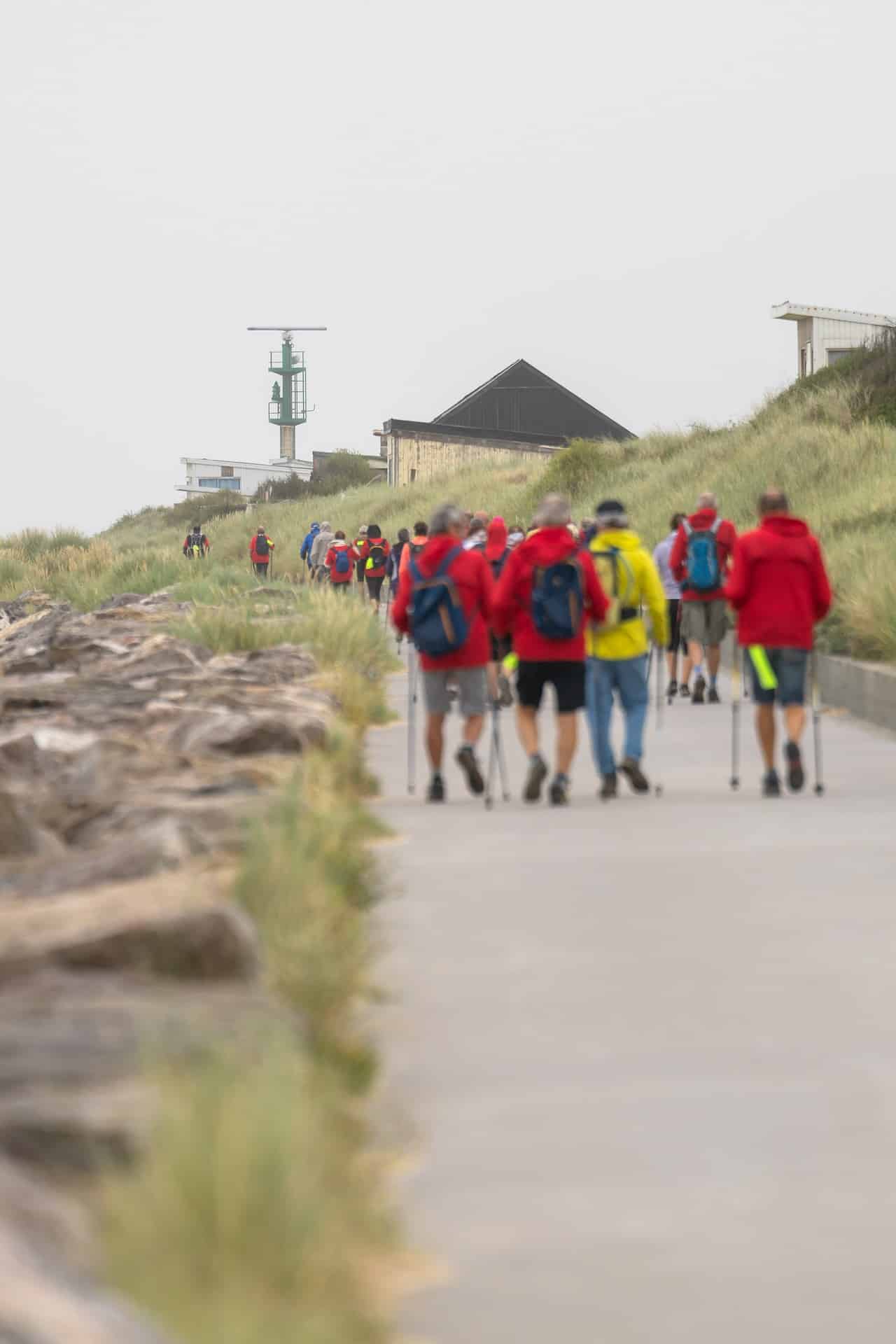
Discover the sea courgain ©Nohcab
 ©Timothé Lovergne
A two-part visit
The maritime discovery room
Before starting the climb, there is time for discovery: this educational and interactive space, with free and open access, traces the history of lighthouses, beacons and maritime signaling, through construction sites, shipwrecks and navigation instruments to test yourself — compass, navisphere, sextant, GPS, anemometer, VHF, sounder… A guide is present to answer questions from visitors, young and old.
 ©Timothé Lovergne
The climb to the summit
A climb of 271 steps
To reach the summit and discover the panorama, you have to climb 271 steps in a spiral staircase. It's a long climb, but perfectly manageable at your own pace, with opportunities to pause and admire the views that regularly appear through narrow windows. At the top of the shaft—which rises to 51 meters, with a focal plane 58 meters above sea level—a balcony offers a 360° panoramic view. City hotel, Notre-Dame, The Calais hinterland, as well as the commercial and passenger ports, are all visible. On a clear day, the English coast can even be seen on the horizon. At a glance, or almost, you can take in most of Calais's must-see sights. For safety reasons, access to the balcony is closed during high winds, storms, or thunderstorms.
Visiting Calais: the must-sees ©Timothé Lovergne
 ©Timothé Lovergne
Behind the scenes at a lighthouse that is still in operation
Above the balcony is the lantern, the heart of the lighthouse and the raison d'être of the entire structure. Not accessible to the public, it protects an optical system composed of four Fresnel lenses, set on a bed of mercury to minimize friction. Contrary to popular belief, it is the optics that rotate around the lamp, which remains fixed. The lamp itself has a power output of only 250 watts, but its beams, concentrated by the lenses, reach 23 nautical miles, or 43 kilometers—more than enough to cover the Strait of Dover.
The lens rotates at a precisely calculated speed to match the lighthouse's signature: four grouped flashes of 0,1 seconds every 2,4 seconds, followed by a 7,4-second period of darkness, for a complete 15-second cycle. It is this precise rhythm, unique to each lighthouse, that allows sailors worldwide to identify Calais by night and by day.
A monument in the heart of the Courgain maritime
A landfall lighthouse, the Calais Lighthouse serves both as a navigational aid for ships entering the port and as a landmark for those navigating the Strait of Dover, the busiest strait in the world. It was listed as a historical monument by decree of April 19, 2011. Nearby, another monument tells the story of the link between the people of Calais and the sea: the Monument to the Rescuers, which pays tribute to the sailors who disappeared during a rescue in 1791 — a good stop to extend the walk in the maritime Courgain.
 ©Nohcab